Sunday, May 16, 2010

"Why Do the Heathen Rage?"

(The Complete Stories, 1971)

I didn't know anything about Flannery O'Connor's story when I picked it today. I needed something relatively short because I had a full day ahead of me. Now I've done a little research and have found out that this story is considered a fragment of an unfinished novel of the same name.

This makes me feel better, because I thought the story just stopped at what could be considered the beginning. I enjoyed the pace before it stopped. A man comes home after having spent two weeks in the hospital after a stroke. We are introduced to his wife and two adult children.

Mary Maud at 30, is a teacher and has a demanding presence.

Walter, 28, is more of a free spirit--"He had the air of a person who is waiting for some big event and can't start any work because it would be interrupted."

Walter has a conversation with his mother about the farm/land and how he will now be in charge of it all--expected to take over and run the place now. Walter will have nothing of it. In fact, he gives his mother the best compliment (which is lost on her):

"Lady, you're coming into your own. You were born to take over. If the old man had had his stroke ten years ago, we'd all be better off. You could have run a wagon train through the Bad Lands. You could stop a mob..."

He's a reader. He writes letters. (he almost reminds me of Flannery).

According to a book review in the NYT, in the 378 pages of the unfinished novel, there are 17 drafts of a porch scene. I wonder if it is the porch scene included in this story. I guess I'll have the opportunity to find out soon enough.

~~J

Saturday, May 15, 2010

"That Tree"

(Flowering Judas and Other Stories, 1940)
(at Andalusia, March 2010)

Katherine Anne Porter begins her story by holding up the main character's dream of being a "cheerful bum lying under a tree in a good climate writing poetry."

Then she smashes that ideal, even though he knew "his poetry was no good"...his yearning for the lifestyle of an artist in a foreign land (Mexico) was considered ridiculous by his first wife, Miriam, so when she finally leaves him he becomes a journalist just to spite her.

We're nearly half-way into the piece before we find out that "the journalist" is sitting in a cafe' where the most "utterly humiliating moment of his whole blighted life" occurred. Not to give too much away, but Miriam had decided to hide under a table instead of hiding behind her man when a precarious situation presented itself.

...but she had no intention of wasting her life flattering male vanity. 'Why should I trust you in anything?' she asked. 'What reason have you given me to trust you?'

The musing and remembering continues until the story between the two has been revealed. End scene....I was searching around to see what others have written about this particular story. I didn't find too much.

The only other story I've read by Katherine was "The Jilting of Granny Weatherall," which had a similar looking back theme. I adored that story--so much so that I wrote two separate papers on it for two separate classes.

I don't know whether or not to like Miriam or the ending. Shouldn't we all be able to follow our dreams? I didn't think the poetry thing was too far fetched. But I would say that.

~~J

Friday, May 14, 2010

"The Day Mr Prescott Died"

(published in Granata, 1956)

(Sylvia Plath)

My goal is to read at least 31 short stories this month in honor of Short Story month. The first ten I chose were from collections written by women. Now I need to "finish" my study in "gender- biased" reading and continue reading short literature by women (Egads!).

Now on to the first story I've ever read written by my favorite poet:

It was a bright day, a hot day, the day old Mr Prescott died.

She lets it all out in the very first sentence of this story, repeating the word "day" three times--which made me smile. As far as standard form is concerned, it is typically against the "rules" to do this--repetition thing. But all rules are meant to be broke, Sylvia--my rebel!

An unnamed narrator (all other characters are named) talks about the day Mr (no period) Prescott died. She isn't exactly sure how to feel because she doesn't "believe in funerals" and the deceased "was a grumpt old man even as far back" as she remembers.

The dialogue is offset by single quotation marks (double is more standard in the U.S.) and seems almost "southern" to me, even though the action takes place in Boston.

Our narrator remains cold and unaffected until after she accidently drinks from the glass that Mr Prescott was drinking brandy from when he dropped dead. Suddenly she feels sick and then has a meaningful conversation with his son, Ben:

'...you think something is dead and you're free, and then you find it sitting in your own guts laughing at you. Like I don't feel Pop has really died. He's down there somewhere inside of me, looking at what's going on. And grinning away.'

'That can be the good part,' I said, suddenly knowing that it really could. "The part you don't have to run from. You know you take it with you, and then when you go any place, it's not running away. It's just growing up.'

Ben smiled at me.

The simplicity of it all is comforting and not at all what I expected to be reading. Have you read any of her poetry? The passion is jarring--in this form she is softer.

~~J

Inventing the Abbotts

Indigo (1997)
Harper Perennial (1999)
I first became aware of this collection because of the film with the same name. Completely enamored by Liv Tyler at the time (I think this was her second role), I wanted to read where the movie came from....it was 1997.

I saw the book somewhere and picked it up--it had the movie poster tie-in cover even. I began reading the story and stopped. Then I lost the book. I found a copy of it the other day for $1.

There are eleven stories, I've managed to finish five.

"Inventing the Abbotts"
----------------------------
The longest story in the collection (30+ pages) and the one that could've been expanded into a novella and or novel. But I'm not making any judgements here, I don't like to hear "this could be a novel" at the end of my own short stories.

It remains true to itself--keeping the same narrator throughout--Doug, the younger of the two Holt brothers. They grow up as outsiders in a small Midwestern town, poorer than the Abbott family. Of course the richest part of the Abbotts lies within the three daughters. They are enough to fill the two brothers lives for a very long time.

The story reminded me a bit of The Virgin Suicides by Jeffrey Eugenides--if only for the fascination of the sisters and the elm disease requiring most of the trees to be cut down.

"Slides"
---------
We get to read the intimate details of Georgia and David's former married life through the seven "dirty" pictures taken early in their life together. They fight for ownership of the slides after they divorce.

"While she made her argument, her hands were in constant motion; and David, lying on their expensive tweed sofa with a coffee mug resting on his chest, watched the sequence of familiar configurations, gestures she had made thousands of times before..."

Herein lies my favorite part of all of these stories. The little snapshots of relationships she seems to capture so well. Everyone knows the sequence of gestures made by someone they love. But I never really realized this until I read that passage.

"Calling"
-----------
Before the advent of cell phones or Caller ID, there was a "secret" little way to check up on someone. The hangup. I mean, or so I've heard (have you read my *69 poem?)...

Two unnamed characters are in that stage of a relationship with "what happens now?" seems to be a looming question. An unanswered question. At first he calls just to hear her voice. Then he becomes a bit possessive and jealous and the calls become more frequent:

"He called her again and let it ring on and on. He lost track of how many times he called her, but them, finally he got a busy signal. The sharp sound startled him, made his heart beat strangely. He dialed again, and got the busy signal again."

Does anyone see the end of this one coming? Keep reading, because you know you want to. Honest, true, and embarrassing moments trump predictability almost every time.

"Expensive Gifts"
---------------------
This is hands down my favorite story (read) in the collection, but I can't really tell you why. There are so many details, both visual and auditory that it all jumps off the page and becomes a living, breathing thing.

The current man: "He was standing naked in silhouette, as slim as a stiletto in the light from the hall...the sight of him gave Kate no pleasure."

The ex-husband: "...with curly brown hair and thick, wire-rimmed glasses which he removed carefully before starting to make love. They left two purplish dents like bruises on the sides of his nose."

Her sleeping son: "His hands were curled into fists, and one thumb rested near his open mouth, connected to it by a slender, almost invisible cord of saliva."

The weather: "It had been a luminous soft gray earlier, and now thick flakes, a darker gray against its gentle glow, brushed silently against the panes."

Kate: "...was, in fact, a reflexive liar. She hated to be unpleasant or contradictory, but when she felt that way, a lie, fully formed almost before she began to think about it, fell from her lips."

The details are all too rich. Too expensive. And even though it's not the "gift" the title is referencing, it is one the author has absolutely given. A bonus.

~~J

Tuesday, May 11, 2010

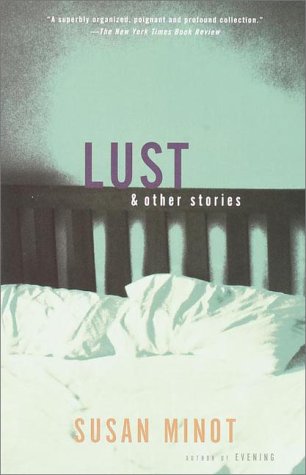
Lust (& other stories)

(Random House--Vintage Contemporaries 1989, 2000)

I came across Susan Minot two years ago through the film Evening. Then I found a short story by her tucked away in one of the literature anthologies (I keep hoarding). Sold!

"Lust"
--------
It was different for a girl.

An unnamed narrator tells the story of 16 men. They come across in snapshots and short paragraphs. There is a focus mostly on the sights and sounds--the perception of them, as she looks back on the events of her youth.

The surrender would be forgetting yourself...

The men are events. They have names (all but one)...and the details get jumbled or left out as she revisits and remembers in a stream of consciousness ode to, well, Lust--which becomes a sort of cautionary tale (sections told in second person).

They're all different...But it's like faces; you're never really surprised.
Still, you're not sure what to expect.


But she's not talking about faces here.

"The Break-up"
----------------
Meet Liz and Owen. They have been together for 8 months and seem to be living together in a small apartment in the city. It's hot. The air, the darkness, it is a Friday night in July.

Roused from their bed by a ringing phone--Liz answers and then lets Owen know that Tim is coming over.

Tim is Owen's best friend and is apparently in the throngs of a bad break-up. He's drunk and walking the streets. When he finally makes it there the snatches of a story begin about Sonia.

Sonia and Tim and there not so perfectness but "Nothing's perfect." (Thanks, Tim)

Liz listens as they sit in the dark. Owen doesn't really pay attention to the bleeding drunk heart of his best friend.

She was trying to keep him talking.
One of her theories was that people should talk all the time.

We find out that Tim was ready to propose, and he puts his anger squarely on Liz. This is how things go. After Own walks Tim out we find out that he is going to try to get Sonia back and had a warning for Owen:

"He also told me to watch out with you."

"What do you think he meant by that?"


"The Knot"
-----------
Told in four tiny sections we get to follow a couple as they are Happy (delusional), Fighting (facing reality), Apart (still mad), then finally Recovering.

Peter and Cynthia do a great job at representing a lot in just five pages. It's heavy in dialogue and realizations. It may be my favorite of the ones I've read by Susan Minot.

Sparse but filled with truth.

"The Man Who Would Not Go Away"
-------------------------------------------
Rounding out her collection, is a story that seems to happen mostly in the head of our narrator. She is not crazy, her thoughts are based on reality. She's coping. She is trying to "get over" a man.

Still, traces of him remained. At first, it was his name. I avoided the people he knew.

Very relate-able. I would say. Kinda gave me the same feeling as that episode of Sex and the City when Carrie keeps seeing Big after their first break-up. My heart was saying, "I hear ya, sister."

She seems him everywhere. Or the energy of him is everywhere. The restaurant--she feels she is sitting in the same chair she sat in one time with "the man." He materializes in other people when she goes to the movies (to escape).

When she meets a guy at a club, he happens to be a guy she only knew through "the man." So when he taps her on the shoulder she feels herself blush as she realizes who he is.

This is not what I expected. This is not what I thought he'd leave behind.

When she is finally able to find some time alone, not bombarded by the ghosts of "him" she realizes that she really never knew him at all.

My favorite lines come near the beginning of the story: Uncertainty is like a drug. It quickens the blood, wears on the nerves.

~~J

Saturday, April 17, 2010

Soft Maniacs (stories)

(Simon & Schuster, 1999)
I may be cheating a bit here, or "back-blogging"...but I thought it was important to talk about the first collection of "short literature" I ever fell in love with...or can remember falling in love with...

The year was 1999 and as a wayward student at a university, when someone says, "Hey do you want to go to a reading?"...you go. It doesn't matter whether or not you know the author/spoken word mistress. You just GO! So I did.

Maggie Estep read to us from her current (at the time) collection of stories--and I was hooked... Maybe it was the "style," maybe it was the "concept," maybe it was Maggie herself.

When I found my own copy (at a used bookstore less than a month later) I was quite excited. I brought the book back to my dorm room and the next thing I remember is my group of friends and I sitting in a circle reading from it...aloud.

(We also took turns reading each other's sexual astrology from a different book, but that's another story altogether)

There are nine semi-related stories in Soft Maniacs where we get to follow two different women (Katie and Jody) as seen by the men they love/ruin...it's actually narrated by them (the men).

It's a gritty, dirty romp--a very quick read. The story I remember the most (and tell people about when I talk about the book) is "The Patient:"

"The bullet traversed my prefrontal cortex and went out my right temple, but I'm fine. I've better than I ever was, actually. They tell me I've, in effect, lobotomized myself. And I understand perfectly that this should be disastrous. I should be upset. But I'm at peace.

...Because I know, better than most, girls are trouble."

Saturday, April 10, 2010

In Addition To:

(or I have to change this thing up or my head might explode)

It was a great idea: read everything ever written by a single author.

It may be the best idea ever, really (right up there with Nutella or White Chocolate Peanut Butter) BUT it takes a greater person to accomplish such a feat.

Maybe one day I will be able to say I've read all F. Scott has written, but not this year (or next year or the year after that)...

Instead I'm going to continue this blog but with a twist--I am going to include other authors. More short stories written by said authors...it will be more about the short story as a literary form.

Yay Short Stories!

This way I can include classics and "new ones" and all the stuff in between...like the sandwich I want to consume right now....I don't have the two delicious spreads mentioned above--but I'm sure I can find SOMETHING to nom nom nom.

~~J