Tuesday, May 11, 2010

Lust (& other stories)

(Random House--Vintage Contemporaries 1989, 2000)
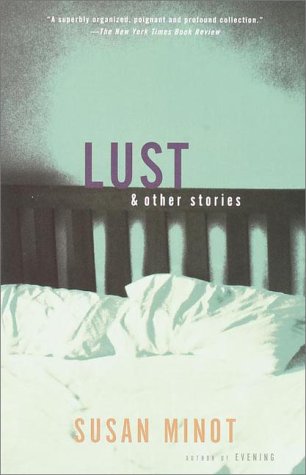
I came across Susan Minot two years ago through the film Evening. Then I found a short story by her tucked away in one of the literature anthologies (I keep hoarding). Sold!

"Lust"
--------
It was different for a girl.

An unnamed narrator tells the story of 16 men. They come across in snapshots and short paragraphs. There is a focus mostly on the sights and sounds--the perception of them, as she looks back on the events of her youth.

The surrender would be forgetting yourself...

The men are events. They have names (all but one)...and the details get jumbled or left out as she revisits and remembers in a stream of consciousness ode to, well, Lust--which becomes a sort of cautionary tale (sections told in second person).

They're all different...But it's like faces; you're never really surprised.
Still, you're not sure what to expect.


But she's not talking about faces here.

"The Break-up"
----------------
Meet Liz and Owen. They have been together for 8 months and seem to be living together in a small apartment in the city. It's hot. The air, the darkness, it is a Friday night in July.

Roused from their bed by a ringing phone--Liz answers and then lets Owen know that Tim is coming over.

Tim is Owen's best friend and is apparently in the throngs of a bad break-up. He's drunk and walking the streets. When he finally makes it there the snatches of a story begin about Sonia.

Sonia and Tim and there not so perfectness but "Nothing's perfect." (Thanks, Tim)

Liz listens as they sit in the dark. Owen doesn't really pay attention to the bleeding drunk heart of his best friend.

She was trying to keep him talking.
One of her theories was that people should talk all the time.

We find out that Tim was ready to propose, and he puts his anger squarely on Liz. This is how things go. After Own walks Tim out we find out that he is going to try to get Sonia back and had a warning for Owen:

"He also told me to watch out with you."

"What do you think he meant by that?"


"The Knot"
-----------
Told in four tiny sections we get to follow a couple as they are Happy (delusional), Fighting (facing reality), Apart (still mad), then finally Recovering.

Peter and Cynthia do a great job at representing a lot in just five pages. It's heavy in dialogue and realizations. It may be my favorite of the ones I've read by Susan Minot.

Sparse but filled with truth.

"The Man Who Would Not Go Away"
-------------------------------------------
Rounding out her collection, is a story that seems to happen mostly in the head of our narrator. She is not crazy, her thoughts are based on reality. She's coping. She is trying to "get over" a man.

Still, traces of him remained. At first, it was his name. I avoided the people he knew.

Very relate-able. I would say. Kinda gave me the same feeling as that episode of Sex and the City when Carrie keeps seeing Big after their first break-up. My heart was saying, "I hear ya, sister."

She seems him everywhere. Or the energy of him is everywhere. The restaurant--she feels she is sitting in the same chair she sat in one time with "the man." He materializes in other people when she goes to the movies (to escape).

When she meets a guy at a club, he happens to be a guy she only knew through "the man." So when he taps her on the shoulder she feels herself blush as she realizes who he is.

This is not what I expected. This is not what I thought he'd leave behind.

When she is finally able to find some time alone, not bombarded by the ghosts of "him" she realizes that she really never knew him at all.

My favorite lines come near the beginning of the story: Uncertainty is like a drug. It quickens the blood, wears on the nerves.

~~J

Saturday, April 17, 2010

Soft Maniacs (stories)

(Simon & Schuster, 1999)
I may be cheating a bit here, or "back-blogging"...but I thought it was important to talk about the first collection of "short literature" I ever fell in love with...or can remember falling in love with...

The year was 1999 and as a wayward student at a university, when someone says, "Hey do you want to go to a reading?"...you go. It doesn't matter whether or not you know the author/spoken word mistress. You just GO! So I did.

Maggie Estep read to us from her current (at the time) collection of stories--and I was hooked... Maybe it was the "style," maybe it was the "concept," maybe it was Maggie herself.

When I found my own copy (at a used bookstore less than a month later) I was quite excited. I brought the book back to my dorm room and the next thing I remember is my group of friends and I sitting in a circle reading from it...aloud.

(We also took turns reading each other's sexual astrology from a different book, but that's another story altogether)

There are nine semi-related stories in Soft Maniacs where we get to follow two different women (Katie and Jody) as seen by the men they love/ruin...it's actually narrated by them (the men).

It's a gritty, dirty romp--a very quick read. The story I remember the most (and tell people about when I talk about the book) is "The Patient:"

"The bullet traversed my prefrontal cortex and went out my right temple, but I'm fine. I've better than I ever was, actually. They tell me I've, in effect, lobotomized myself. And I understand perfectly that this should be disastrous. I should be upset. But I'm at peace.

...Because I know, better than most, girls are trouble."

Saturday, April 10, 2010

In Addition To:

(or I have to change this thing up or my head might explode)

It was a great idea: read everything ever written by a single author.

It may be the best idea ever, really (right up there with Nutella or White Chocolate Peanut Butter) BUT it takes a greater person to accomplish such a feat.

Maybe one day I will be able to say I've read all F. Scott has written, but not this year (or next year or the year after that)...

Instead I'm going to continue this blog but with a twist--I am going to include other authors. More short stories written by said authors...it will be more about the short story as a literary form.

Yay Short Stories!

This way I can include classics and "new ones" and all the stuff in between...like the sandwich I want to consume right now....I don't have the two delicious spreads mentioned above--but I'm sure I can find SOMETHING to nom nom nom.

~~J

Sunday, March 14, 2010

"Outside the Cabinet-Maker's"

FROM: The Fitzgerald Reader: A Collection of His Finest Work
[1963 Scribners] Edited by Arthur Mizener, pgs. 297-301

(room in an antique dollhouse)

Originally published in The Century Magazine (1928), this one is just under 1,500 words and is the shortest "short" story by F. Scott I have read thus far. It might be his shortest even, I'd have to do research to find out if that is true.

Either way, it is charming and has nothing to do with love-lost, but instead the imagination of a little girl and the relationship between father and daughter take center stage. None of the characters are named even, so it's enchanting.

An automobile stops and out pops a lady, who disappears into a Cabinet-Maker's shop to conduct business. Revealed through the story is the reason she is there--and F. Scott even puts the key sentences in French.

(I had to look these up, and it didn't bother me one bit)

A gift for the little girl is being bargained for--and it can't cost more than "Twenty dollars." Father and daughter stay outside and construct a magical story together, while watching the people moving about the neighborhood:

“Who is the lady?”

“She’s a Witch, a friend of the Ogre’s.”

The shutter blew closed with a bang and then slowly opened again.

“That’s done by the good and bad fairies,” the man explained. “They’re invisible, but the bad fairies want to close the shutter so nobody can see in and the good ones want to open it.”

“The good fairies are winning now.”

“Yes.” He looked at the little girl. “You’re my good fairy.”

Finally the lady comes out and the Father finds out that the gift costs more than they hoped, at twenty-five dollars--but apparently it will be made anyway.

As quickly as it began, it is over. Short and very sweet. Refreshing.

~~J

Saturday, March 6, 2010

"A New Leaf"

from: Perrine's Literature: Structure, Sound, and Sense
edited by Arp and Johnson (8th Edition, 2002)Pages 439-453

Welcome to 1931. Or at least that's when this particular story was first published in the Saturday Evening Post. I found the text in one of the used literature anthologies I seem to grab whenever they are within reach.

"A New Leaf" is in a chapter dedicated to "Evaluating Fiction." The student is instructed to pay close attention to things like plot, structure, characterization, theme, point of view, symbols, allegories, fantasy, humor, and irony (did you catch all that?).

There are even eight questions that follow to direct thoughts. Good stuff. Nevertheless, I shall ignore all the rules and opine on the story as I normally do.

By far, my favorite section of the story occurred first--opening scene as Julia spies Dick Ragland, as he briefly stops to speak to the man she is having dinner with:

She sat there, a well-behaved women of twenty-one, and discreetly trembled....

"He's without doubt the handsomest man I ever saw in my life."

"Yes, he's handsome," he agreed without enthusiasm.

"Handsome! He's an archangel, he's a mountain lion, he's something to eat. Just why didn't you introduce him?"

If I had a dollar for every time...okay. I don't think those words have ever left my mouth, but I am dying to use the line as soon as possible.

But, of course, Dick is trouble. He's not well-received. He's a drunk. Which is all the more reason for Julia to fall madly and deeply, despite the fact that he shows up both drunk and hungover for the first planned meeting.

The rest is predictable. Well, maybe not exactly--but there will be disappoint and it is rather anti-climactic, even though F. Scott throws in a bit of mystery when we hear of the final action through another character.

"Better let it all alone in the depths of her heart and the depths of the sea." Aye, aye captain.

~~J

Monday, March 1, 2010

"Bernice Bobs Her Hair"

from: The Short Stories of F. Scott Fitzgerald
edited by Matthew J. Bruccoli (Scribners, 1989)Pages 25-47

(original artwork from the Saturday Evening Post)

Originally published in 1920, I wasn't sure what to expect from this story--I knew it was one of F. Scott's most read/discussed and just the title alone makes me think of flappers, short hair, and prohibition.

You too?

Well, it turned out to be fantastically accurate in the "game" of womanhood. (unfortunately) Think Mean Girls (or Heathers or any other coming-of-age story where the girls carve each other up).

I can't reveal the end, but it's good--and I didn't see it coming...

Marjorie made no answer but gazed pensively at her own image in the mirror.

"You're a peach to help me," continued Bernice.

Still Marjorie did not answer, and Bernice thought she had seemed too grateful.

"I know you don't like sentiment," she said timidly.

Marjorie turned to her quickly.

"Oh, I wasn't thinking about that. I was considering whether we hadn't better bob your hair."

Bernice collapsed backward upon the bed.

Oh yes, there will be scissors...especially since a boy is involved (Warren), but I am very curious about the 3,000 words F. Scott reportedly removed from the story in order to get it published.

Which makes me think of my own work and what I submitted to several creative writing programs in hopes of being accepted. This line of thinking is not related to story specifically, except for the art of editing.

I guess you just "know" what to cut and not to cut? (pun intended).

~~J

Thursday, February 11, 2010

"Absolution"

FROM: The Fitzgerald Reader: A Collection of His Finest Work
[1963 Scribners] Edited by Arthur Mizener, pgs. 76-90


Forgive me F. Scott, for I have sinned. It's been....(you can check the log) since I last read you. I've been busy (not a lie) but I'm sure I couldn't squeezed a page or two in somewhere.

So they say "Absolution" (June 1924) is the false-start of The Great Gatsby. Okay. I'll go with that. I guess. I think it's a bit strange and the flashback section/repetition is maybe overdone. But what do I know, really?

I had to "look up" my Commandments because I didn't know them in proper order (because our dear boy, Rudolph Miller mentions them by number)--as in, he says he has violated the Sixth and Ninth.

Rudolph had now exhausted the minor offenses, and was approaching the sins it was agony to tell. He held his fingers against his face like bars as if to press out between them the shame in his heart.

"Of dirty words and immodest thoughts and desires," he whispered very low.

"How often?"

"I don't know."

"Once a week? Twice a week?"

"Twice a week."

"Did you yield to these desires?"

"No, Father."

While I was reading, all I could think about was a story a classmate wrote for my Fiction Writing class...involving confession and a priest. We got to hear the priest's inner-most thoughts as he say through a round with his parishioners.

Want to know the truth? I came up with the entire idea for the story.

I didn't write it, mind you--and he knocked it out of the park.

Okay. Back to F. Scott.

I don't want to give away the sin, but I will tell you that Rudolph has the best imagination and has a "character" or alter-ago with the most wonderful name: Blatchford Sarnemington.

Now I shall do my best to read you more often, my dear author.

~~J